
Home › Off-duty work › By agency › Wisconsin State Patrol

Wisconsin
Wisconsin State Patrol and outside work
A policy that starts by defining the word. For the State Patrol, “employment” is providing a service — whether or not anyone pays you for it.
- What it is called
- Outside employment
- Who approves it
- Supervisor, with the Region Commander
- Approval expires
- 31 December, every year
- Decision due in
- Five working days
The definition is the widest thing on this page
Most agencies in this section define off-duty work by who pays and how much. P&P 11-8 defines it by what you do. Under General Provisions A, “employment” means the provision of service, whether or not in exchange for a fee or other service. There is exactly one carve-out: voluntary charity work with a bona fide charitable organisation.
Read that plainly and the unpaid favour is inside the policy. Helping a friend's business at weekends is the provision of a service; so is an unpaid role with an organisation that is not a charity. An officer who assumes the rule only bites when money changes hands has misread it.
The starting position is permissive, though, and the policy says so twice. Employees may accept outside employment, including outside business activities, so long as it does not interfere with or create a real or potential conflict of interest with their state duties. The Division's stated reasons are practical rather than moral: some outside work could put an officer in a position where they are asked to compromise Division policy, and some carries a high risk of temporary or disabling injury that would stop them doing the job they are paid for.
One prohibition catches people by surprise because it has nothing to do with policing. Working for another state agency is generally prohibited — not on conflict grounds, but because of Fair Labor Standards Act and overtime issues. A second state paycheque creates a wage-and-hour problem for the employer, so the answer is usually no.
Ten categories that start out refused
The policy lists examples presumed to involve actual or potential conflicts of interest. They will not be approved unless the employee is able to affirmatively establish otherwise — the burden sits on the trooper, not on the Division. The list is expressly not all-inclusive, so something absent from it is not thereby approved.
1. A motor carrier company or wrecker operation. 2. A motor vehicle dealer, distributor, wholesaler, salvage dealer, auto auction or auto pool. 3. Motor vehicle insurance salesperson. 4. Motor vehicle crash insurance adjuster or investigator, including crash scene photographer. 5. Crash scene reconstructionist, unless five conditions are met. 6. Any employment involving the sale, manufacture or transport of alcoholic beverages. 7. Bill collector or credit investigator. 8. Tavern or dance hall security guard. 9. Establishments selling pornographic books, magazines, sexual devices or videos, or otherwise providing entertainment or services of a sexual nature. 10. Any gambling establishment not exempted by law.The shape of that list is worth noticing. Six of the ten are about traffic and vehicles — carriers, wreckers, dealers, salvage, insurance sales, crash adjusting and reconstruction. This is a traffic enforcement agency, and the conflicts it guards against are the ones its own casework creates. A trooper who investigates crashes on Monday and adjusts crash claims on Saturday is the exact problem the policy is built around.
Item 4 is unusually specific and easy to trip over. Crash scene photographer is named in terms. Photography reads like a neutral trade, and an officer taking freelance scene work for an adjuster would very likely not think of it as insurance work at all.Crash reconstruction: the one exception, and its five conditions
Reconstruction is the only category on the list that comes with a route through. It is permitted unless — and the conditions are drawn to keep the trooper away from anything their own agency has touched.
The employee shall not become involved: (a) in cases where an on-duty State Patrol officer was the investigating officer or reconstructionist; (b) in civil cases where criminal action is still pending; (c) in civil cases where the State of Wisconsin is the defendant; (d) in civil cases where the defendant is a law enforcement agency or a peace officer acting in the performance of their duties; and (e) in any crash where they have had previous involvement on an on-duty basis — which the policy spells out as any crash where the reconstructionist was physically present at the scene, regardless of his or her role.
That last clause is the strict one. Presence is the test, not participation. A reconstructionist who attended a scene to assist, to observe, or for any reason at all is out of that case permanently, and no later distance repairs it.
What the policy explicitly does not restrict
Item 11 of the same list is not a prohibition. It states that there are no general restrictions on occupations requiring motor vehicle operation, and that any restriction on driving work would have to come from the general conflict-of-interest rule instead, read against the WisDOT Transportation Administrative Manual, the work rules and the Code of Ethics.
For a traffic agency that is a deliberate line to draw. Driving for a living is not presumed to be a conflict; driving for a motor carrier is, because that is an industry the State Patrol regulates and inspects. The distinction is between the activity and the employer.

BlueShifts. Plan Your Year. Own Your Time.
The shift calendar built for your rotation, off-duty work, and life on and off the clock.
Save your shift schedule once and BlueShifts fills the rest of the year in.
Working for another police agency, and for security firms
This is permitted, and it is governed by five parameters rather than a flat rule.
The Division of State Patrol has first priority to an employee's services for both regular and overtime assignments. The outside work must not conflict with the Division's scheduling or staffing requirements, and must not compromise the employee's ability to perform their duties as a trooper or inspector. No state kit crosses over. Department of Transportation or Division-issued equipment, uniforms, forms, materials and supplies may not be used in furtherance of outside employment. And the liability release runs both ways. The employee and the outside employing agency release the State of Wisconsin, the Department of Transportation and the Division from any liability incurred while working for the other agency. That is a condition on the hiring agency as much as on the trooper, which means it has to be settled before the work starts rather than assumed. None of it is available during initial probation. Employment with other law enforcement agencies is not permitted while the employee is on initial probation with the Division.One expiry date for the entire division
Most agencies on this site run a rolling permission — approved in March, expires the following March. Wisconsin does not. All approvals of outside employment automatically expire on 31 December of each year, whoever holds them and whenever they were granted.
So the renewal is a single division-wide deadline, and the policy attaches a lead time to it: renewal applications must be submitted to the immediate supervisor 15 days in advance of expiration, on the WisDOT Outside Employment Approval Request, form DT1117. An approval granted in November is worth about six weeks before it needs renewing, and the paperwork for that renewal is due about two weeks after it was issued.
The clocks on the answer are published too, which is rarer than it should be. A request shall be approved or denied within five working days of receipt by the person authorized to decide it, and denials must state the reason in writing. The Superintendent or designee reviews all requests and affirms or reverses initially denied ones within 10 working days, unless that period is extended.Two powers point the other way. The Superintendent may reverse a previously approved request if deemed necessary, with prompt written notice to the employee and their commander. And an immediate supervisor, or the next level up, with the concurrence of the Region Commander, WSPA Commander or Section Supervisor, may suspend or revoke an approval already granted where the circumstances are found to conflict with the policy or with what the original application said. An approval in hand is not a settled thing.
One structural detail: requests made by Region Commanders, the WSPA Commander, Section Chiefs or above are reviewed at the next highest level, so nobody approves their own.
What sits behind the policy
P&P 11-8's own reference list names the authorities it rests on, and two are statutes. Wis. Stat. ch. 19.45 is the state ethics code for public officials, and ch. 946.13 is the criminal provision on private interest in a public contract. The policy also points to Wisconsin Administrative Code ch. PERS-24, WisDOT Transportation Administrative Manuals 20, 413-1 and 413-2, the Department and Division work rules, and the Law Enforcement Code of Ethics.
The Division Code of Conduct, P&P 11-3, carries the underlying obligation: no outside work without prior authorisation. So the failure to ask is a conduct matter in its own right, separate from whatever the work itself would have been.
This version of 11-8 is dated 16 July 2018 and supersedes a version dated 12 February 2014. It is six pages.
Vehicles
Policy does not say who pays
The rule is a condition attached to the kind of work a detail actually is. P&P 11-8 allows employment with other law enforcement agencies, or security work for a private business or non-profit, on five parameters — and one of them is that Department of Transportation or Division of State Patrol issued equipment, uniforms, forms, or materials and supplies will not be utilised in the furtherance of outside employment. Alongside it: the Division has first call on the trooper for both regular and overtime work, and the trooper and the hiring agency both release the State from liability. Approvals expire on 31 December whoever holds them.
Common questions
Who approves outside employment for a Wisconsin State Patrol trooper?
The request goes on form DT1117 to the employee's immediate supervisor, and is approved or denied by the Region Commander, WSPA Commander or Section Chief. It must be decided within five working days, and a denial has to state the reason in writing. Requests made by commanders and above are reviewed at the next highest level.
When does approval expire?
On 31 December, for everyone. Approvals do not run twelve months from the date they were granted — they all expire on the same date across the division, and renewal applications are due to the immediate supervisor 15 days before that.
Can a Wisconsin trooper do private crash reconstruction work?
Yes, but it is one of the categories presumed to be a conflict, so it is refused unless the trooper affirmatively establishes otherwise, and five conditions apply. The strictest is that they may not take any crash where they were physically present on duty, whatever their role was that day.
Does the policy apply to unpaid work?
Yes. The policy defines employment as the provision of service whether or not in exchange for a fee or other service. The only exclusion is voluntary charity work with a bona fide charitable organisation.
Can a Wisconsin trooper work for another law enforcement agency?
Yes, subject to five conditions: the State Patrol has first priority on the trooper's time for both regular and overtime assignments, the work must not conflict with Division scheduling or staffing, it must not compromise their duties, no state-issued equipment or uniform may be used, and both the trooper and the hiring agency must release the State from liability. It is not permitted at all during initial probation.
Sources
- Wisconsin State Patrol P&P 11-8, Requests for Approval of Outside Employment or Activities — read in full16 July 2018, six pages, superseding the version dated 12 February 2014 · Wisconsin Department of Transportation
- Wisconsin State Patrol P&P 11-3, Division of State Patrol Code of Conduct — the requirement of prior authorisation for outside work24 July 2018 · Wisconsin Department of Transportation
Not confirmed as the latest version. The policy is hosted by WisDOT rather than by wsp.wi.gov, and the manual moved hosts at some point without the filenames keeping their year stamps, so an older link to this policy will fail even though the document is current. The division's own index at wisconsindot.gov is the reliable route to it. Several authorities that 11-8 leans on have not been read here — the WisDOT Transportation Administrative Manuals 20, 413-1 and 413-2, Administrative Code ch. PERS-24, and the Department work rules — and any of them could add conditions this page does not carry. The WLEA collective bargaining agreement was checked and contains no outside employment article, so the policy is the whole of the bargained picture.
Checked 18 August 2026. Every statement on this page comes from the documents above, as published on that date. Agencies revise policy and renegotiate agreements — follow the links for the version in force today, and tell us if something here no longer matches.
How off-duty work runs generally
- How details get assigned
- Getting approved
- Getting paid, and chasing what is owed
- The rules and the limits
Other agencies in Wisconsin
One deadline, the whole division, every year — and it is easy to be the one who misses it
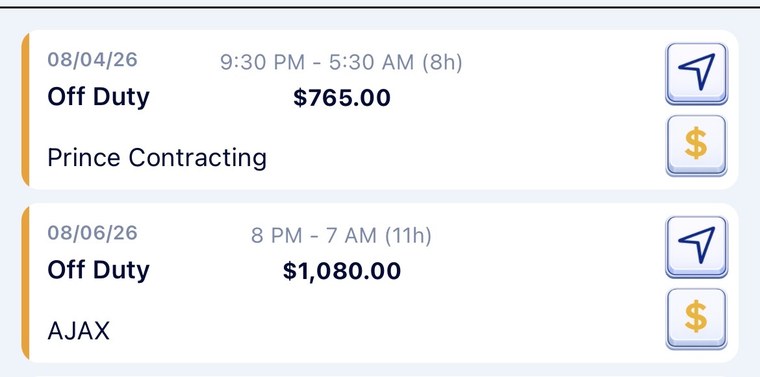
Because every State Patrol approval dies on 31 December and the renewal is due 15 days before, the date that matters is fixed and known a year in advance. BlueShifts holds that as a recurring reminder against the job it belongs to, and keeps each approved employer, what the work paid and the miles on the same calendar as your shifts — so the renewal is a note you already have rather than something remembered in the last week of December.
Scan to install